In a world saturated with information and responsibilities, the stacks of paper on our desk, in our backpack or even in the glove compartment of the car often seem like anchors holding us back. Invoices, contracts, class notes, business cards, prescriptions; each sheet is a tangible reminder of a pending task, of a piece of data we cannot afford to lose. This accumulation is not only physical clutter, but mental clutter too. And what if you could turn that chaos into a flawless digital archive, organized and accessible from anywhere, with a single click?
This is not a futuristic promise, but a concrete reality thanks to a tool you already have: your smartphone. Document scanner apps have revolutionized the way we deal with paper, turning your phone's camera into a portal to a world without clutter. However, not all tools are the same. Many free solutions come with a catch: annoying watermarks that strip your documents of their professionalism, or essential features hidden behind paywalls.
This article is a guide to navigating that universe and finding the true gems: scanner apps that are not only powerful and versatile, but also genuinely free and respectful of your work, without imposing watermarks. It is not just about technology; it is about taking back control, simplifying your life and easing your mental load. Get ready to discover how to turn clutter into order, anxiety into efficiency, and your pocket into the most powerful office you have ever imagined.
1. More Than a Photo: What Is a Document Scanner and Why Is It Essential?
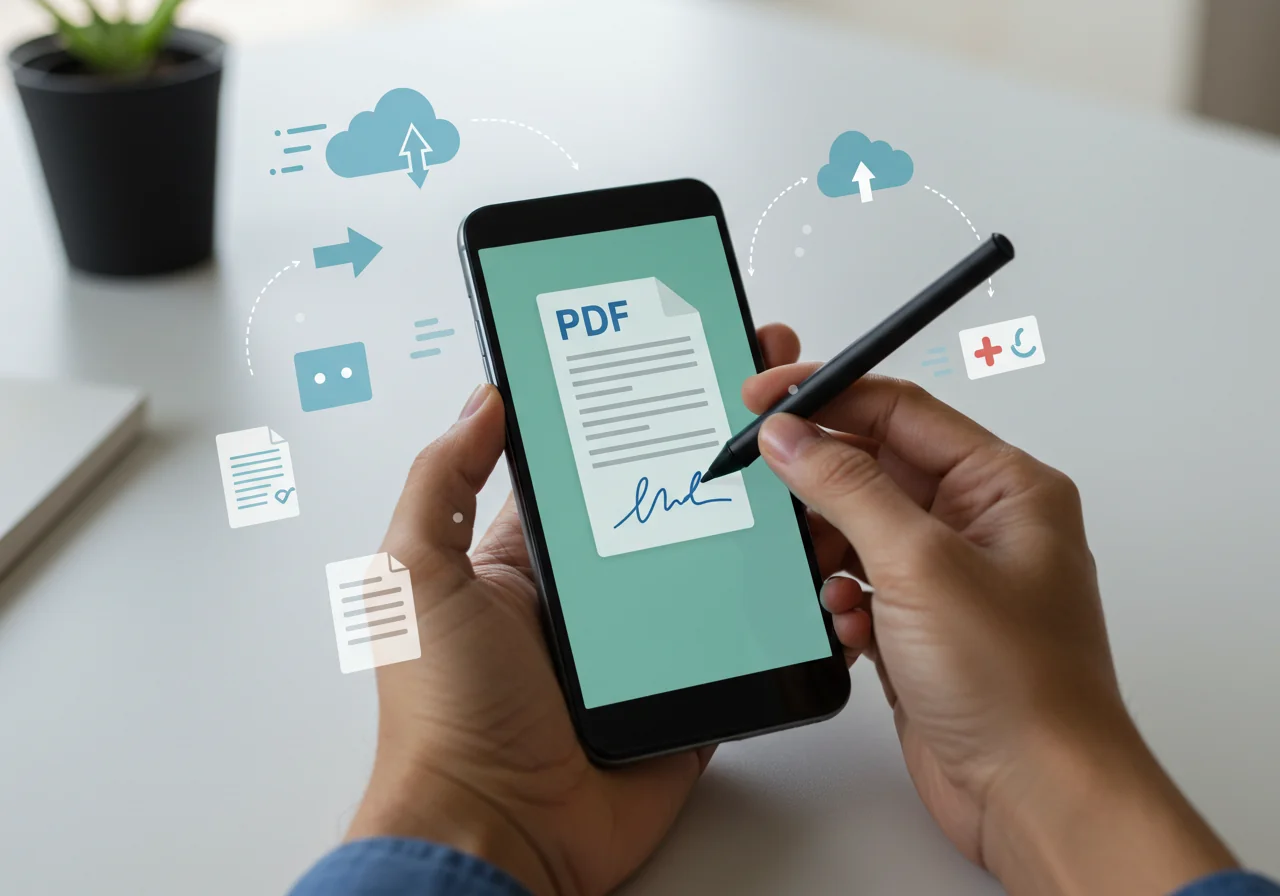
At first glance, it may seem that a scanner app simply takes a photograph of a document. However, its function is far more sophisticated and its value immensely greater. Unlike a simple photo, a document scanner app is designed with intelligent algorithms to detect the edges of the paper, correct the perspective (eliminating the odd angles that appear when you are not perfectly above the document) and improve the legibility of the text, often applying filters that increase contrast and eliminate shadows. The result is not an image, but a clean, clear and professional digital document, usually in PDF or JPG format.
A diferença fundamental está na intenção e no resultado. Enquanto uma foto captura um momento, um escaneamento preserva e otimiza a informação. Além disso, muitos desses aplicativos incorporam uma tecnologia transformadora conhecida como Reconhecimento Óptico de Caracteres (OCR, na sigla em inglês). O OCR “lê” o texto dentro da imagem escaneada e o converte em texto digital. Isso significa que o seu documento escaneado se torna editável e, mais importante, o conteúdo dele passa a poder ser pesquisado. Imagine poder encontrar um contrato específico pesquisando uma única palavra-chave num arquivo com centenas de documentos. Essa é a mágica do OCR.
The impact of adopting this technology in your day-to-day life, both personal and professional, is profound and multifaceted:
- Organização e Acessibilidade: Transforma arquivos físicos e montanhas de papel numa biblioteca digital organizada em pastas no seu celular ou na nuvem. Você pode acessar qualquer documento, a qualquer momento e de qualquer lugar.
- Profissionalismo: Enviar um documento escaneado de alta qualidade, sem distorções nem marcas d’água, projeta uma imagem de profissionalismo e atenção aos detalhes, seja para um trabalho da faculdade, uma candidatura a emprego ou um relatório para um cliente.
- Segurança e Backup: Os documentos físicos são vulneráveis a perdas e a danos por água ou fogo. Um arquivo digital, especialmente se tiver backup na nuvem, é uma cópia de segurança confiável que protege você contra imprevistos.
- Eficiência e Produtividade: Reduz drasticamente o tempo que você gasta procurando informações. A capacidade de pesquisar texto dentro dos seus documentos permite encontrar o que precisa em segundos, não em horas.
- Sustentabilidade: Ao digitalizar os seus documentos e adotar um fluxo de trabalho sem papel, você contribui para reduzir o consumo de papel, de tinta e da energia associada à impressão, causando um impacto positivo no meio ambiente.
In essence, a scanner app is not just a utility; it is a tool of empowerment that lets you take control of your information, optimize your workflows and, ultimately, simplify your life.
Pergunta para reflexão: Pense no seu espaço de trabalho ou na sua casa. Quais pilhas de papel geram mais estresse ou bagunça, e como o seu dia a dia poderia mudar se você pudesse digitalizá-las de forma eficiente?
2. The 'Free' Labyrinth: Common Challenges When Choosing a Scanner App
The app market is flooded with options advertised as 'free', but the user experience often tells a different story. Navigating this landscape can be frustrating and lead to disappointment, causing many people to abandon the search for a digital solution. Recognizing these common challenges is the first step to avoiding them and making an informed decision.
Usual Barriers and Frustrations:
- A Praga das Marcas d’Água: Este é talvez o obstáculo mais visível e irritante. Você dedica tempo a escanear um documento, ajusta tudo à perfeição e, ao exportá-lo, descobre que uma marca d’água com o logo do aplicativo foi estampada sobre o seu trabalho. Isso não só é esteticamente desagradável, como pode comprometer o profissionalismo de um documento importante, como um currículo ou uma fatura.
- Hidden Paywalls: Many apps offer scanning for free but lock essential features behind a subscription. Functions such as OCR (text recognition), exporting to certain formats like PDF, scanning multiple pages into a single document, or removing the watermark often require payment. You only realize this after investing time learning to use the app.
- Intrusive Advertising: To monetize free versions, some apps bombard the user with ads. These can be annoying banners that take up screen space or, worse, full-screen ads that interrupt your workflow just as you're about to save or share a document. This experience can be so disruptive that it makes the app practically unusable.
- Usage Limits: Another common "freemium" model is limiting how many scans you can make, either per day or in total. You scan five documents without problems, but on the sixth, the app asks you to upgrade to a paid version. This is particularly problematic when you need to digitize a large volume of documents.
- Privacy and Security Concerns: When scanning documents, you often handle sensitive information: personal, financial, or confidential data. Not all apps are transparent about how they handle your data. Some may store your scans on their servers without adequate encryption or, in the worst cases, share your data with third parties. It is essential to choose apps from trustworthy developers with clear privacy policies.
- Poor Scan Quality: Not all scanning technology is the same. Some free apps lack sophisticated image processing algorithms, resulting in low-quality scans with poorly detected edges, blurred text, or distorted colors, leaving the final result unprofessional and even illegible.
Facing these challenges can lead to the limiting belief that "there is no good free solution" or that "to get quality, you have to pay." While it is true that developers need to sustain their businesses, there are companies that offer incredibly powerful tools for free as part of a larger ecosystem, without resorting to these frustrating practices. The goal is to identify these trustworthy providers.
Question for reflection: Have you ever had a frustrating experience with a "free" scanner app in the past? Which of these challenges was most bothersome for you and why?
3. Your Digital Allies: The Best Free Scanner Apps With No Watermarks
Fortunately, the maze of scanner apps has clear and bright ways out. There are tools developed by some of the world's most respected technology companies that offer exceptional functionality completely free of charge, without watermarks and without the frustrations mentioned above. Here we present the best options, detailing their strengths so you can choose the one that best fits your ecosystem and needs.
1. Adobe Scan: The Gold Standard for PDF
- Developer: Adobe, the creators of the PDF format.
- Availability: Android and iOS.
- Ideal for: Users seeking maximum image quality, powerful OCR, and seamless integration with the Adobe ecosystem.
For many people, Adobe Scan is the best free scanner app available. The quality of its image processing is exceptional, using artificial intelligence to automatically detect edges, correct perspective, eliminate shadows, and improve text sharpness.
Main Features (Free):
- No watermarks and no scan limits.
- Automatic high-precision OCR: Every document you scan is automatically converted into a PDF with selectable and searchable text.
- Multiple capture modes: Includes specific modes for documents, business cards (automatically capturing contact information), whiteboards, and forms.
- Image cleanup and enhancement: You can remove unwanted spots or marks from your scans.
- Integration with Adobe Document Cloud: Your scans are automatically saved to Adobe's free cloud, allowing you to access them from any device.
Quick Usage Guide:
- Open the app and point the camera at the document. Adobe Scan will detect it and capture the image automatically.
- If you have multiple pages, just keep scanning; the app groups them into a single document.
- When finished, tap the thumbnail to review. You can reorder pages, crop, rotate, or apply color filters.
- Tap "Save PDF." The document will be saved to your Adobe Document Cloud, with OCR already applied, ready to be shared without any watermark.
2. Microsoft Lens (formerly Office Lens): The Perfect Companion for Office
- Developer: Microsoft.
- Availability: Android and iOS.
- Ideal for: Students and professionals who make heavy use of the Microsoft ecosystem (Word, PowerPoint, OneNote, OneDrive).
Microsoft Lens is an incredibly versatile and powerful tool, designed to integrate seamlessly with other Microsoft applications. Its ability to export to editable formats is its greatest differentiator.
Main Features (Free):
- No watermarks and no ads.
- Export to multiple formats: You can save your scans not only as PDF, but also directly to Word (.docx) or PowerPoint (.pptx) as editable documents. It can even transcribe text from a whiteboard directly into OneNote!
- Smart capture modes: Like Adobe, it offers modes for documents, whiteboards, business cards, and photos.
- Immersive Reader: A unique accessibility feature that can read aloud the text of your scans.
- Integration with OneDrive: Saves your scans directly to your Microsoft cloud storage.
Quick Usage Guide:
- Select the capture mode at the bottom (Document, Whiteboard, etc.).
- Frame the document. The app will highlight the edges and take the photo.
- After capturing, you can add more pages or tap “Confirm”.
- On the export screen, choose the desired format. If you choose Word, the app applies OCR and delivers an editable Word document with the text and formatting of the original.
3. Google Drive Scanner: Simplicity Built In
- Developer: Google.
- Availability: Android (integrated into the Drive app) and iOS (through the Drive app).
- Ideal for: Android users and anyone deeply integrated into the Google ecosystem who wants the fastest and simplest solution.
It is not a standalone app, but a feature built directly into the Google Drive app. It is the most minimalist and straightforward option, perfect for quick scans without installing anything additional.
Main Features (Free):
- No watermarks, no ads, no complications.
- Direct saving to Google Drive: Your scans become PDFs and are saved instantly to the Drive folder you choose.
- Basic editing tools: Lets you crop, rotate and adjust the color of the scan.
- Basic OCR (server-side): Once the PDF is in your Drive, Google processes the file so its content can be searched, although not as immediately as with Adobe Scan.
Quick Usage Guide (on Android):
- Open the Google Drive app.
- Tap the floating “+” button and select “Scan”.
- Take a photo of the document. Adjust the crop if necessary.
- You can add more pages by tapping the “+” icon.
- When you finish, tap “Save”. Choose the file name and the destination folder in your Drive.
4. Genius Scan: The Trusted Veteran
- Developer: The Grizzly Labs.
- Availability: Android and iOS.
- Ideal for: Users looking for an independent and robust alternative with a strong focus on privacy.
Genius Scan is one of the oldest and most respected scanner apps. The free version is very functional and imposes no watermarks, making it an excellent choice if you prefer not to depend on the Google, Microsoft or Adobe ecosystems.
Main Features (Free Version):
- No watermarks and unlimited scans.
- On-device processing: Unlike other apps, most of the image processing is done on your phone, offering an extra layer of privacy.
- Smart page detection and perspective correction.
- Several export options: You can export your documents to other apps as PDF or JPG.
- Batch mode: Lets you quickly scan dozens of pages in a row.
Limitations of the Free Version:
- OCR and direct integration with cloud services (such as Dropbox, Google Drive, etc.) require the paid version (Genius Scan+). However, you can always export the PDF to your cloud service app manually.
Practical exercise: Choose one of these four apps, the one that best fits the tools you already use (for example, Microsoft Lens if you use Word, or Google Drive if you are a heavy Android user). Install it and scan three different types of documents you have on hand: an invoice, a book page and a business card. Try the cropping and filter options to get familiar with the process.
4. From Chaos to Clarity: Building a Sustainable Digital Archive
Having the right tool is only half the battle. The real transformation happens when you develop a system and habits to keep your digital documents organized and secure in the long run. A well-structured digital archive is an asset that will save countless hours and stress in the future.
Tips for a Foolproof System:
- Set Up a Logical Folder Structure: Before you start scanning in bulk, think of a folder structure that makes sense to you. You can organize them by areas of your life (e.g., “Personal Finance”, “Work”, “Health”, “Education”) and then create subfolders (e.g., inside “Personal Finance”, you might have “Invoices 2025”, “Taxes”, “Insurance”). The key is consistency.
- Adopt a Clear Naming Convention: A file named “Scan_10_10_2025.pdf” won't tell you anything six months from now. Create a standard format for naming your files. For example:
AAAA-MM-DD - Descrição - Empresa.pdf(e.g.,2025-10-09 - Fatura Eletricidade - Endesa.pdf). This makes your files identifiable at a glance and extremely easy to sort chronologically. - Process Scans Immediately: Don't let scanned documents pile up in a digital “downloads” folder. As soon as you scan something, take 30 seconds to rename it and move it to the correct folder. This small habit keeps digital clutter from replacing physical clutter.
- Take Advantage of OCR: When you choose an app like Adobe Scan or Microsoft Lens, which performs OCR automatically, get used to using the search function of your cloud service or computer. Instead of browsing through folders, it is often faster to search directly for a keyword such as “warranty” or a person's name to find the document you need.
- Make Backups: The golden rule of digital data is the 3-2-1 rule: keep at least 3 copies of your important data, on 2 different types of media (e.g., your computer and an external hard drive), with 1 copy off-site (in the cloud). By saving your scans to services such as OneDrive, Google Drive or Adobe Cloud, you already fulfill the most important part of this rule.
- Ensure Capture Quality: To get the best results, follow these practices when scanning:
- Good Lighting: Scan in a well-lit area to avoid shadows.
- Contrasting Background: Place the document on a dark surface if the paper is white, and vice versa. This helps the app detect the edges more accurately.
- Stay Calm: Hold the phone as parallel as possible to the document to minimize distortion. Good apps correct perspective, but starting from a good capture always helps.
Dealing with Challenging Situations:
- Long Documents: Use the batch or continuous scanning feature. Don't try to pause between each page. Simply keep flipping through the pages and capturing. Review the order at the end.
- Old or Crumpled Documents: Try to smooth the document out as well as possible. The "Black and White" or "High Contrast" filters in apps usually do an excellent job of improving the legibility of faded text.
- Security for Sensitive Documents: For documents such as passports or confidential contracts, consider using an additional layer of security. Some applications or cloud services offer "secure vaults" or password-protected folders that require additional authentication for access.
Question for reflection: How could you structure your digital folders to reflect the different areas of your life? Sketch a small folder map on paper to visualize your ideal digital archive.
5. The Harvest of Digitization: Long-Term Benefits of a Paperless Life
The decision to adopt a digital workflow and organize your documents with these free tools goes far beyond having a tidy desk. It is an investment in your future self, paying dividends in the form of greater peace of mind, efficiency and control. The long-term benefits intertwine across every aspect of your life, creating a domino effect of positivity.
Lasting Impact on Your Well-Being and Productivity:
- Radical Reduction of Stress and Mental Load: The anxiety of not knowing where an important document is disappears. The mental burden of remembering where you put each paper is lifted, leaving more mental space for creativity, problem-solving and deep thinking. Knowing that all your vital information is organized and secure brings a profound sense of calm and control.
- Exponential Time Savings: Think of all the hours you have lost searching for a piece of paper. Now imagine recovering that time. Over months and years, the time saved by finding documents instantly adds up to days and weeks you can devote to your passions, your family or your professional development.
- Faster and More Informed Decision-Making: Need to compare the terms of an old insurance policy with a new one? Check the warranty on an appliance? Review a contract before an important call? Having instant access to relevant information lets you make decisions with more confidence and agility, without delays.
- Professional Flexibility and Mobility: Your office is no longer tied to a physical place. With your documents in the cloud, you can work, study or handle your personal affairs from anywhere in the world. This freedom lets you seize opportunities and meet needs more effectively, without being limited by where your files are located.
- Enhanced Security and Disaster Resilience: A fire, a flood or a simple loss can destroy years of paper files. A digital archive, properly saved in the cloud, is immune to these physical disasters. Your most important documents are protected by the robust security infrastructure of companies such as Google, Microsoft and Adobe.
- Simplified Collaboration: Sharing a digital document is as simple as sending a link. This eliminates the need for photocopies, faxes or postal mailings, speeding up collaboration with colleagues, clients or family members. You can give your partner access to an entire "household documents" folder or share a project with your work team effortlessly.
In short, the path to a paperless life is not a technological fad; it is a fundamental strategy for living and working more intelligently, not more heavily. It is an act of self-care that gives you order, time and tranquility, allowing you to focus on what truly matters.
Question for reflection: If you had a perfectly organized digital archive today, which task or process in your life would become immediately easier or less stressful?
Your First Scan Toward Freedom
We traveled from the chaos of paper piles to the clarity of a digital archive, discovering that the tools for this transformation are not only accessible but genuinely free and already waiting in your pocket. You learned to tell a simple photo apart from an intelligent scan, to navigate the confusing world of "free" apps, and to identify the true champions, such as Adobe Scan, Microsoft Lens and Google Drive, which offer incredible power without watermarks or hidden costs.
Knowledge is the first step, but action is what creates change. The invitation now is to begin. You don't need to digitize your entire life in one afternoon. The greatness of this process lies in its simplicity and in the power of small, consistent steps.
Choose one of the recommended apps. Install it right now. Pick up that bill lying on the table, that meeting note or that recipe you don't want to lose, and make your first scan. Give it a name following a clear logic and save it. Feel the small victory of turning a vulnerable physical object into a secure and accessible digital file.
Every document you scan is a step toward lightening your load, clearing your mind and building a system that will work for you in the years to come. This is no longer just another item on your to-do list; it is the beginning of a new way of interacting with your world, one that is more organized, efficient and serene. The power is in your hands. The journey toward clarity begins with a single tap.